

Quick Brief
- The Launch: Oracle unveiled Retail Supply Chain Collaboration on January 11, 2026, at NRF in New York a cloud-native platform integrating AI-powered risk mitigation with supplier management capabilities
- The Market: AI in supply chain management market valued at $3.5 billion in 2023, projected to reach $22.7 billion by 2030 (30.3% CAGR) as retailers combat ongoing disruption costs
- The Impact: Enables real-time supplier oversight, compliance automation, and predictive disruption alerts for retailers managing global vendor networks
- The Timing: Arrives as 76% of European shippers experienced over 20 supply chain disruptions in 2024, with major incidents causing losses up to 42% of annual EBITDA
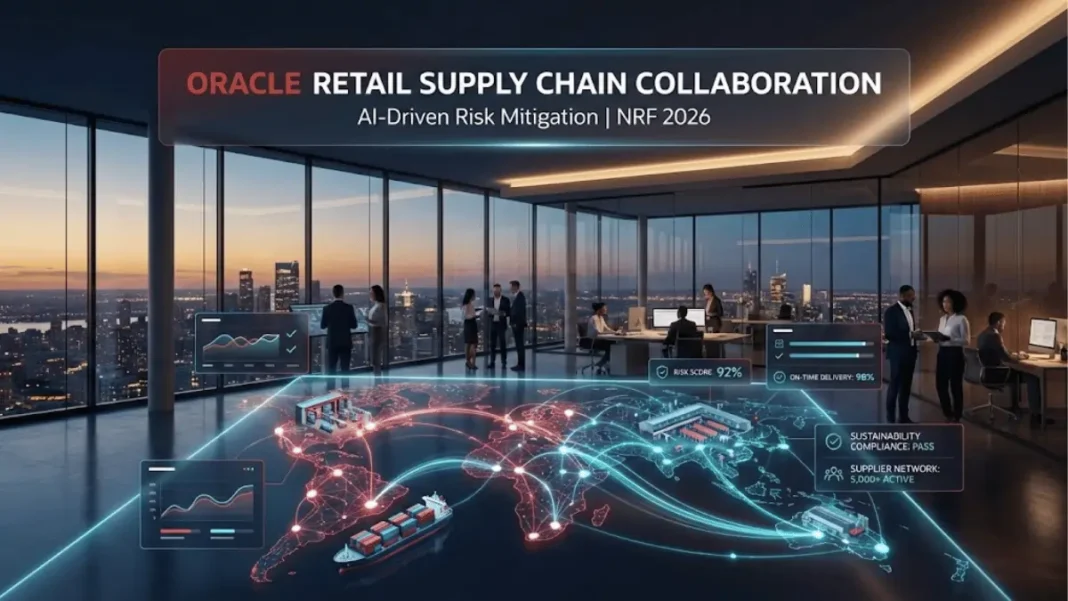
Oracle unveiled Oracle Retail Supply Chain Collaboration on January 11, 2026, at the National Retail Federation’s annual conference in New York, introducing a cloud solution designed to address escalating supplier volatility through AI-driven visibility and compliance automation. The platform integrates directly with Oracle Retail Merchandising Foundation Cloud Service (MFCS), creating a unified interface for vendor assessment, facility audits, and regulatory alignment. Paul Woodward, Oracle’s global vice president of retail products, stated the solution delivers “AI-and data-driven visibility and intelligence needed to navigate complex supply chain and vendor relationships to help mitigate financial, operational, and reputational risks“
Architecture of Oracle Retail Supply Chain Collaboration
The platform operates as a cloud-native solution built on Oracle’s infrastructure, leveraging MFCS APIs for one-way data synchronization that auto-generates product records at style or SKU levels using supplier and item codes as common identifiers. Retailers gain access to categorized activity lists that organize process workflows by status and responsibility, while assignment list views enable direct status updates for processes, activities, sites, and documents without navigation overhead. The system supports urgent notification broadcasting to suppliers, triggering expedited acknowledgments and next-step actions when consumer demand shifts or regulatory changes threaten inventory timelines.
Planned AI digital assistant capabilities will enable natural language queries to retrieve and summarize supplier information, reducing manual search time across vendor databases. The compliance module allows customizable audit notifications, delivering targeted communications to specific stakeholders rather than organization-wide alerts. Integration depth extends to pre-selection processes, where retailers assess production facilities and site conditions before onboarding, establishing baseline metrics for ongoing vendor performance reviews.
Key benefits include data sharing and collaboration with suppliers, sustainability certification collection, evaluation and pre-selection scoring through audits and surveys, streamlined merchandising through centralized supplier portals, and contextual workflows for merchandising data approval.

AdwaitX Analysis: Market Position in the AI Supply Chain Sector
Oracle’s retail-specific deployment aligns with aggressive cloud growth targets, as the company reported 27% cloud revenue growth (IaaS plus SaaS) to $6.7 billion in fiscal Q4 2025 (quarter ended May 31, 2025), with remaining performance obligations reaching $138 billion. Cloud infrastructure revenue grew 52% year-over-year to $3 billion, while SaaS applications revenue increased 12% to $3.7 billion. Oracle management projected total cloud growth rate will increase to over 40% in fiscal year 2026.
Oracle is positioned as a leader in five Gartner supply chain reports in 2025, demonstrating enterprise adoption across logistics and merchandising verticals. The company’s cloud remaining performance obligations grew 41% year-over-year, with cloud RPO representing nearly 80% of total RPO and expected to grow over 100% in fiscal year 2026.
The financial incentive for retailers remains substantial. Supply chain disruptions cost businesses approximately $184 billion in 2025, though this represented an 88% reduction from peak disruption levels. McKinsey research indicates companies can lose up to 42% of a year’s EBITDA due to a single major disruption, particularly those without diversified sourcing strategies. Oracle’s platform addresses these pain points through predictive alerts for demand fluctuations and regulatory shifts, targeting the 76% of European shippers who experienced over 20 disruptive events in 2024.
The AI in supply chain management market was valued at $3.5 billion in 2023 and is projected to grow at 30.3% CAGR to reach $22.7 billion by 2030, driven by increasing demand for operational efficiency and data-driven decision-making. Oracle’s entry into retail-specific supply chain collaboration positions the company to capture enterprise spending on AI-powered forecasting, inventory optimization, and supplier risk management.
Technical Specifications and Compliance Features
| Feature | Oracle Retail Supply Chain Collaboration | Market Context |
|---|---|---|
| Deployment Model | Cloud-native SaaS integrated with MFCS | AI supply chain market growing 30.3% CAGR through 2030 |
| Integration | Native MFCS API connectivity, auto-sync at SKU/style level | Direct integration reduces manual data entry and synchronization errors |
| AI Capabilities | Predictive disruption alerts, planned NLP assistant for supplier queries | Planned AI digital assistant for natural language supplier information retrieval |
| Compliance Tools | Customizable audit notifications, ESG tracking, regulatory change monitoring | Addresses ESG reporting mandates and cross-border compliance requirements |
| Workflow Management | Categorized activity lists, assignment list views with quick status updates | Streamlines retailer-supplier collaboration through organized process tracking |
The platform differentiates through vertical integration rather than horizontal breadth. Oracle embeds retail-specific workflows including style-level merchandising, supplier pre-qualification, and compliance workflows aligned with ESG mandates. The solution enables retailers to collaborate with suppliers on data sharing, collect sustainability certifications, evaluate facilities through pre-selection scoring, and manage merchandising through centralized portals.
Deployment Timeline and Enterprise Adoption Strategy
Oracle demonstrated the solution at NRF booth #5739 beginning January 11, 2026, targeting immediate deployment for existing Oracle Retail Merchandising Foundation Cloud Service customers. The solution addresses three regulatory pressures: ESG reporting mandates, compliance documentation for cross-border trade, and supplier labor practice verification increasingly required by consumer-facing brands.
Adoption timelines depend on MFCS integration status. Retailers already operating Oracle Merchandising Foundation Cloud Service gain API-level connectivity, while new deployments require full MFCS onboarding before accessing Supply Chain Collaboration modules. The AI digital assistant capabilities remain in development, with Oracle yet to specify general availability dates for natural language supplier search.
Oracle management indicated supply constraints remain the primary limiting factor for Oracle Cloud Infrastructure growth, with customer capacity requests pushed into future quarters due to data center buildout timelines. The company continues expanding its cloud infrastructure footprint to meet enterprise demand for AI-enabled applications across supply chain, finance, and ERP verticals.

Frequently Asked Questions (FAQs): Oracle Retail Supply Chain Collaboration
What is Oracle Retail Supply Chain Collaboration?
A cloud platform launched January 11, 2026, providing AI-driven supplier risk management, compliance tracking, and predictive disruption alerts for retailers managing global vendor networks.
How does AI improve retail supply chain operations?
AI analyzes demand patterns, regulatory changes, and supplier data to forecast disruptions, automate compliance notifications, and reduce manual vendor assessment time through planned natural language assistants.
What retailers can use Oracle’s new platform?
Enterprises operating Oracle Retail Merchandising Foundation Cloud Service gain direct integration capability with the new Supply Chain Collaboration solution.
What is the cost of supply chain disruptions for retailers?
Supply chain disruptions cost businesses approximately $184 billion in 2025, with major incidents causing losses up to 42% of annual EBITDA for affected companies.
When will Oracle’s AI assistant feature launch?
Oracle has not announced general availability dates for the planned AI digital assistant enabling natural language supplier queries and data summarization.

